
Harnessing the Power of Cultural and Linguistic Connection

group of professionals at a table

It’s your first encounter with someone you just met from a different culture and background that speaks a language other than English. How are you able to communicate with them? In the past, many Americans’ initial approach would be to ask “Do you speak English?” However, as society becomes more and more diverse and the frequency of exposure to diverse cultures increases, people are realizing the benefits of acquiring and maximizing their language skills to effectively communicate with others.

There are numerous ways that you can harness the power of cultural and linguistic connection. With technological advancements we no longer have to travel to experience cultural and linguistic diversity. It’s at our fingertips; it’s as easy as joining a social media platform such as LinkedIn or Facebook, joining groups, and engaging with people from all over the globe. Further, since the pandemic, many people are moving to different places around the U.S., so the opportunities to interact with different cultures typically found in larger cities like New York and Los Angeles are now more frequent throughout smaller communities and expanded to places where a variety of cultural and linguistic expressions were previously not as present. Additionally, remote work options allow us to do some globetrotting and experience new places while making a living from the comfort of our homes. An unexpected outcome of working remotely is that being able to communicate with others in-language, in-context, and in-culture has become even more important to not only navigate work and social situations, but in life in general.

In a recent episode of “Language is Your Superpower” podcast, Host Lisa March and guest Marcos Villar, Executive Director at ALIANZA, have a conversation regarding how language and cultural proficiencies are critical for civic engagement and community impact programs. Marcos shares, “There is nothing like sitting in front of a person, or even screen-to-screen, and being able to engage in their language.” The ability to effectively communicate in another language and discover how to translate and transfer thoughts, ideas, concepts, and knowledge with others in your native or non-native language is an increasingly sought-after ability in today’s society.

Oftentimes, as people learn or become proficient in another language, their native accent or distinct way of pronouncing words become a feature of their communication that many speakers become self-conscious about. However, it’s all about perspective. Marcos explains, “My accent is my asset, not my liability. It means that I speak two languages, or three, or four. It means that you can speak to and relate to more people, than a person that only speaks one language. It means I don’t have to force people to come to me in my language. I can share my thoughts, my ideas, and my knowledge with you in either language.”  This is a prime example of how language can be your superpower!

So, exactly how do you harness your superpower and ability to speak two, three, or more languages? You can showcase it on your social media posts, use your language skills to give back to your community, or use it as a competitive advantage when seeking job opportunities, to name a few. One way to proclaim that “Yes, I speak English and another language” is by obtaining a digital badge that showcases your language proficiency. This helps others become aware of which languages you can effectively communicate in and enhances your ability to make meaningful connections.

To learn more about how to harness your language superpower in more than 120 languages, visit LTI today!
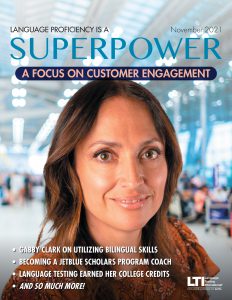

Meet a Language Superhero: Gabby Clark

Gabby Clark

The 2019 survey commissioned by the American Council on the Teaching of Foreign Languages (ACTFL) titled “Making Languages Our Business,” reveals that the demand for employees with foreign language skills is rapidly growing, and nine out of ten employers rely on employees with language skills other than English (p. 3).

As the report states: “A command in multiple languages is a valuable asset for U.S. students and employees–not only in boosting their marketability in the workplace, but in helping them thrive in a global economy.” (p. 3) In other words, multilingualism gives you a special power: a power to communicate in another language, a power to better understand other cultures, a power to earn college credit, and a power to advance professionally.

Every year, thousands of professionals take the ACTFL language assessments with LTI to certify their language skills and use the official credentials to showcase their multilingualism. One of these professionals is Gabby Clark, a Scholars Program Coach at JetBlue. Gabby, a 10-year veteran at JetBlue, has had a successful career and leveraged her multilingualism to not only advance professionally but also to earn college credit and connect with her Guatemalan family.

We hope you take the time to read Gabby’s story and get inspired to get your language skills certified.

Click to read and/or download Gabby’s story: Gabby-Clark-story

Mitigating Conflict and Fostering Mutual Understanding with Language Proficiency

three professionals having a discussion at a table

At Language Testing International, we have seen countless ways in which language proficiency skills alone have benefited our customers in their professional, academic, and even in their personal lives. However, when a person’s language proficiency skills are combined with cultural competency, the value that person brings to the table grows exponentially. A culturally competent person with the ability to effectively communicate in another language can help create understanding or even mitigate potential conflicts.

In a recent episode of LTI’s “Language Is Your Superpower” podcast, Marcos Vilar, the Founder of the non-profit organization ALIANZA Center, discussed the value of combining cultural competency with language proficiency, “because the next step after language is understanding all the cultural nuances that are behind a language.”  Marcos Vilar was born in Puerto Rico and moved to the mainland United States when he was a teenager. Today, he also runs Vilar Strategies, a public relations consulting practice in Orlando, FL, which serves clients in strategic planning, community advocacy, and not-for-profit organizational development and management.

Marcos has led major efforts to activate Latino civic engagement at a national and local level and created a coalition of Latino-led organizations dedicated to increasing Latino participation in the electoral process in key states. His language proficiency in both English and Spanish and life experiences that have afforded him competency in both Puerto Rican and American cultures, have uniquely positioned him to help navigate and mediate various interactions between his native island of Puerto Rico and the continental United States.

One example of this was when Vilar was “hired by the National Association of Realtors and by the Puerto Rico Association of Realtors, to basically rebuild and reconstruct their organization that had gone through some troubled times. And they needed somebody in there that could understand the American way of doing business at the National Association and someone who could understand the Puerto Rican way of doing business—the Puerto Rican Association of Realtors.” Both the National Association of Realtors and the Puerto Rican Association of Realtors are the same association. However, Vilar explained that “the two different cultures of those two bodies, which are related, (one is an affiliate of the other) are completely different.”

Marcos provided more context for the differences between these two groups: “they’re basically formed in a legal framework from two different legal ways or legal tendencies, the Roman law and the British law. All of the romance languages; Spain, France, Italy, all of those countries … they have the legacy of the Roman law. And the Roman law is very prescribed. If it’s not written down specifically, it’s not a law, and there’s very little room for interpretation,” On the other hand, Marcos differentiates that “the British law is much more condensed, much more general … it leaves a lot more space for interpretation. … It’s flexible. It adapts to the condition and the time.”

You might now be thinking to yourself, “I thought we were talking about language and culture, not legal frameworks.” To expound on this, Marco gave the example that “we in the United States speak English. And that is a language, but it’s also a legal system, a legal psychological construct of how we do business. It’s all set up in law. And how we set up law in language and how the language works even, all of that plays into the cultural context that that individual and that society brings into any scenario.”

Marcos was aware of these legal and linguistic constructs, “having lived in the United States for so long, having experience with both cultures in a very profound way, being that [I] studied here in the United States, but also having grown up in Puerto Rico.” This “gave [me] a lot of tools to be able to navigate and negotiate between the association in Puerto Rico and the association at the national level.” Through this and other similar experiences, Vilar stated that he “learned a lot and became aware, in a much deeper sense, of all of those nuances, that it’s not just linguistic, but it’s also cultural.”

As we shared before, language proficiency skills on their own are extremely valuable. But when language proficiency is combined with cultural competency, whether learned naturally through one’s upbringing or through one’s life experiences—or both in Vilar’s case—those language proficiency skills can yield a deeper level of understanding, create situational context, and even help mitigate potential conflicts!


To learn more about Marcos Vilar’s story, tune into our most recent podcast.

Diversity of Hispanic Leadership

volunteer giving presentation

The values and cultural preferences of individuals who identify as Hispanic are unique and distinct. So does the concept of leadership—what it should look like, sound like, and how it should be represented by Hispanic leaders in their communities. The diversity that exists within the Latino population means that leaders must use certain skillsets and engage differently. Different doesn’t mean any less proficient, less productive, or less impactful. In fact, quite the opposite is true.

In a recent Language is Your Superpower podcast, guest Marcos Villar, Executive Director of ALIANZA, a civic organization in Florida aimed at uniting the Puerto Rican and Hispanic community, stated, “We don’t prescribe [sic] to the idea that our community does not have leaders. We are surrounded by leaders everywhere…sometimes they don’t fit the leadership structure of a particular area (i.e., local government, region, etc.).” In the realm of leadership development, ALIANZA works with the community to encourage them to exercise tu voz or “your voice” by supporting better understanding of their individual and collective roles in social, economic, and environmental justice movements in the Latino and broader community. Three (3) attributes that you may find in Hispanic leaders that are directly linked to their diverse backgrounds are:

  • Linguistic diversity and proficiency: Many Hispanics are bilingual (English and Spanish) or Spanish dominant, and they may or may not be linguistically proficient in navigating the regional or local landscape in which they may want to lead, irrespective of their command of English. A language difference does not equate to a leadership deficiency. Rather, it may require identifying the leadership qualities of the Spanish speaker and helping them learn how to communicate effectively within an English dominant environment.
  • Culturally diverse backgrounds and upbringing: Latinos, Hispanics, or people that self-identify as Latinx connect to the cultural norms, beliefs, and way of living of the greater Hispanic population, but also to the subcultures of which they are a part. For example, Hispanics from the northeastern region of the U.S. such as New York or Chicago who are first, second, or third generation born in the U.S. have lived experiences that seamlessly integrate both cultures. In comparison, Hispanics that recently moved to the mainland U.S. may not thoroughly command the English language and cultural nuances, including those of other Latinos they meet. Hispanic culture is not monolithic, rather it is culturally rich and linguistically diverse in its dialects, interpretation of context, and social norms, which is influenced by each individual’s country of origin, unique personal experiences, and socioeconomic status. So, once newcomers learn how to navigate their new communities here in the U.S., culturally and linguistically, their contributions to society are felt even more.
  • A passion for serving people: A collective and underlying belief of many Hispanics is that enhancing the life of one is to enhance the life of all, to serve one is to serve all and that when I benefit, we all benefit. That belief often drives their passion to serve.

Regardless of their nationality or heritage, natural leaders acquire the necessary attributes to serve their communities as they are exposed to opportunities which help groom them into becoming great leaders. Such is the case of Maribel Gomez Cordero, a County Commissioner in Central Florida who is a social worker that “currently is the bridge and the voice that connects the County with the Community” (Orange County, FL Board of Commissioners, 2021, para. 7). She has become well known in the community for her years of unselfish advocacy and work with the homeless, the Hispanic community, and people in need. Due to her work in the community with the homeless and with faith-based organizations, she decided to run for Commissioner. Her first attempt was unsuccessful, but she remained determined in her unwavering desire to serve her community. Eventually, she was successful in her civic pursuit to becoming a County Commissioner as continued to become more proficient in English.  She now uses her language superpower to translate county-related communications from English into Spanish to ensure that her community is aware and understands what is going on. Marcos Villar stated, “She is a nonstop warrior for her community.”

With leadership, there is no “one size fits all” and that is also true for the diversity you will see and experience with Hispanic leaders. The combination of linguistic proficiency, understanding of culture and diversity, and passion for serving others that they have adds value to conventional leadership norms, and heightens the breadth and scope of their positive impact in American society.

Want to know more? Tune into our recent podcast with Marcos Vilar.