
Meet a Language Superhero: Alan Linus Lee–A Modern-Day Renaissance Man

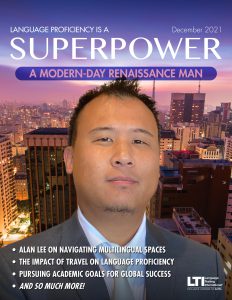
Language Superhero magazine cover: Alan Lee Alan Lee is a modern-day renaissance man. He speaks several languages, has obtained multiple degrees and certificates, and traveled the world both for work and study. He has a great perspective on navigating multilingual and multicultural spaces and the impact of travel on language proficiency. He talked to LTI about his experiences learning languages and taking the ACTFL assessments in order to obtain a language proficiency certificate. He’s a fascinating man, and his story is worth the read.

Read his story: Language-Superpower-Magazine-Alan_Lee


Watch the video to hear directly from Alan about his journey.

Cultural and Linguistic Representation on School Boards

group of people around a table

Did you know that in the 49 U.S. states and Virgin Islands School Board Associations, there are over 90,000 members that are responsible for educating over 50 million children? According to the National School Board Association, approximately 9 out of 10 students receive public education. With over 4.8 million English Learners (ELs), which is equivalent to ~10% of the total K-12 student population enrolled in schools, the linguistic and cultural diversity within education is growing. However, when you look at your local school board, do the members reflect the diversity of the communities they serve?

According to the U.S. Department of Education (2014-15), Hispanic and Latino students represent more than 75% of ELs, which is approximately 25% of the total student population. While statistical data provides insight on the growing number of ELs and the need for increasing support, a perfect example of the need for diverse representation on School Boards with members who intimately understand the challenges these students face can be found in the latest episode of “Language is Your Superpower” podcast series.

Johanna López became the first Latina to become a member of the Orange County Public School (OCPS) Board in Florida in its 170-year history. Ms. López has served for over two decades as the eyes, ears, and voice of students, parents, and educators—especially those who look like her and who experience the most disparities. She champions minority student empowerment with a special focus on English for Speakers of Other Languages (ESOL), supporting undocumented students, responding to their current needs during the COVID-19 pandemic, and advocating for the provision of better treatment for teachers and non-instructional staff.

Historically, school boards have been led predominantly by members who did not reflect the cultural and linguistic demographics of their districts, but the tides are slowly changing. In a recent article, “Change Is Already Here”, Council of Urban Boards of Education (CUBE) Steering Committee Chair, Jacinto Ramos Jr. states “School boards today are serving a population of students reflective of a major demographic shift in American schools. The country is now more racially and ethnically diverse but also seeing more economic inequality.” The fact remains that the demographics in the U.S. have changed and will continue to do so in the foreseeable future. Therefore, to ensure that School Board members understand the unique challenges of diverse children and create equitable reform that is reflective of their unique needs, there must be cultural and linguistic representation.

Students who are learning English should be empowered to recognize the value of speaking another language as they continue to improve their command of English. In today’s global economy, being multilingual is a high-demand skill. Students who work toward proficiency in another language should be encouraged to pursue the Seal of Biliteracy, an award in the form of a seal on a diploma or transcript that recognizes high school graduates who have attained high levels of proficiency in English and one or more world languages. It recognizes the value of language diversity and acknowledges the effort involved in and importance of learning a language. Having ELs obtain the Seal in their first language and in English will arm them with the credentials to pursue academic and professional opportunities where language skills are of paramount importance.

Tune into the podcast with Johanna López here.

Sources

https://www.nsba.org/About/About-School-Board-and-Local-Governance

https://www2.ed.gov/datastory/el-characteristics/index.html

https://www.nsba.org/ASBJ/2020/February/Change-Already-Here


Why Language Inclusion Is the Key to Effective Community Building

family multigenerational hugging

Anyone in a leadership role quickly learns the value of good communication skills if they want to be effective. This can be especially challenging if language is a barrier between the leader and those they are trying to lead. Language Testing International is proud to have provided language assessment services to many leaders around the world who have taken this challenge head-on.

The reality is that there are still many more leaders in positions of power who never take on this challenge, and ultimately cause sometimes-large segments of their prospective audiences to be left unheard and unattended to. However, we can find inspiration to act from the trajectories of leaders like Johanna López, who joined us as a guest during a recent episode of LTI’s “Language Is Your Superpower” podcast.

Johanna López is a member of the Orange County Public Schools (OCPS) Board in Florida and the first Latina to attain such a prestigious role via landslide vote in 2018. It was the culmination of a strategic campaign fully managed by her former students coupled with an impeccable career as an educator and advocate for marginalized youth. Ms. López is fully aware that she has been tasked by the community she has served for over two decades to be the eyes, ears, and voice of students, parents, and educators—especially those who look like her and who experience the most disparities. She takes this responsibility very seriously in her continued work championing minority student empowerment with a special focus on English for Speakers of Other Languages (ESOL), supporting undocumented students, and advocating for the provision of better treatment for teachers and non-instructional staff.

Ms. López knows first-hand the importance of overcoming language barriers for effective community building. “Number one. You have to go to the community,” she said. “You cannot depend on other people’s opinions or because you are just only reading articles … you have to go to the community and you have to speak with the people who are facing the situations, and not listening to the situations from second-hand opinions.”

Not speaking the language of the community that you serve doesn’t mean you can ignore their needs, explained López. “You have to find somebody who can translate to you what people are trying to say in their native language.” She gave an example that “if you try to make somebody from Puerto Rico, who doesn’t know enough English, explain the situation they are facing, they sometimes cannot describe enough in their second language the way they feel.” In other words, the essence of what someone is saying can literally get lost in translation if the person facilitating communication isn’t fluent enough in the language and doesn’t understand the cultural context and nuances.

During the COVID-19 pandemic, Ms. López advocated for all information from the school system to be translated into every language represented within the schools. “We have a lot of information that sometimes did not go first-hand to our Hispanic community, or the Portuguese-speaking community, or the Vietnamese-speaking community. So, I requested publicly that we have those translations, because it is important. This is about life.”

Due to her efforts, the county’s superintendent agreed to Ms. López’s request and “now they translate the manuals, and they post videos in different languages.” When possible, López says you should try to go beyond just translating from one language to another and address each audience separately. Ms. López did this during the pandemic, “when I had educational town halls, because it was a lot of information, you know, we were changing everything in the system. So, I provided educational forums, one completely in English, for 1.5 hours … and then one completely in Spanish … because when you have the translations, you know, our community is not going to feel the same way. Nobody is going to feel comfortable enough to participate in that town hall. So, I provided it in both languages, one after the other one.”

Ms. López explains the value of treating the school’s diverse employees with inclusive and equitable practices, as those individuals are ultimately who impact the students. “I have a lot of janitors that are Hispanic, so I think they deserve to have the same information in their native language, and also for our bus drivers. … As a school board member, we have to be able to identify the populations and the ethnicities that we have in different areas, so we can provide information and be fair and equal to everybody, because this is our country. We want to be better, to provide good services for our students. If I serve my teachers, my bus drivers, and my janitors, I know for sure the students are going to feel more comfortable. They are going to have better services, because they [are around staff] that are being attended to and valued.”

The approach Ms. López uses for effective community building—by being inclusive of non-English speaking segments of the community she serves—makes it easy to understand why she was the recipient of the prestigious Teacher of the Year award and is a popular School Board member, especially amongst her community’s non-English-speaking populations. The difference Ms. López’s makes in the public school system of her community is a perfect example of the superpowers of language proficiency!

Learn more about Johanna López’s inspiring story by tuning in to our podcast.
Student-led Civic Engagement: Advocating for Their Future

father helping daughter with homework

In a recent podcast in ourLanguage is Your Superpower” series, Johanna López credits her students for her historical 2018 landslide win to become a member of the Orange County Public School Board (OCPS) in Central Florida.  Not only did she obtain a seat with 40,000+ votes (previous elections were won by a margin of closer to 10,000 votes), she also became the first Latina in its 170-year history to be elected. This accomplishment started way before she decided to run for OCPS. It started with the love for her students and creating opportunities for them to advocate for their future.

In Orange County, Florida, 1 in 3 people speak Spanish. In 2018, Spectrum News 13 reported three big trends in Orange County schools:

  • OCPS shows an influx of Hispanic students.
  • Hispanic students make up 41 percent of the county’s school districts.
  • The county is addressing the influx via hiring multilingual, ESOL teachers.

As a native Spanish speaker that taught in Puerto Rico, Johanna quickly realized when she started teaching in the U.S. mainland that there were bilingual opportunities to advocate for and to better serve all students, but particularly those for whom English is not their first language.

For example, with no Spanish representation on the Parent Teachers Association (PTA) in the school she worked at in Orlando, Johanna created a group called “Familias presentes, estudiantes excelentes” (Involved Families, Excellent Students) to increase parent and student engagement. The group quickly grew to over 900 members, especially when Hurricane María forced many Puerto Rican families to move to the mainland U.S. With the increase of the Hispanic community, students were motivated to participate and empowered to use their native language as they learned English and got involved in the community. The bilingual exchange among the students began in the classroom and quickly expanded to campaigning in English and Spanish for Johanna’s campaign for School Board.

When she decided to run for the OCPS School Board, her students quickly rallied to support her. As part of the campaigning process, her students were charged with educating the Hispanic community about Johanna’s candidacy and the role of the School Board. This involved going door-to-door, speaking to members in the community, which made many students feel self-conscious and unsure of their linguistic skills. Johanna explains, “With my accent, I have to set an example to them, so they feel enough comfortable [sic] to knock on those doors and try their best to speak English to the community. It was a challenge for me and for them, but we achieved our goal.”

This student-led civic engagement opportunity allowed not only Johanna, but more importantly her students, to realize that despite language barriers or linguistic limitations, they have the capacity to learn, grow, and advocate for their future. Johanna proudly proclaims, “My accent is an asset.” She also taught her students that, “It is not the accent. It’s about passion. It’s about engagement. It’s about community. It’s about being transparent. People know when you are trying your best. They value that.”

Multilingual skills are highly valued in today’s economy. High school students who are multilingual can have their skills recognized by obtaining the Seal of Biliteracy. The Seal is approved by 45 states, and it recognizes high school graduates who have attained high levels of proficiency in English and another world language. This award not only recognizes the value of language diversity, but it also provides employers and college admissions offices with a method of identifying those who are multiliterate.

Are you interested in bringing the Seal of Biliteracy to your school? ACTFL and LTI are proud to support the Seal of Biliteracy by offering proficiency- and performance-based assessments for learners in grades 9-12. Over 600,000 students have earned this distinction that is available in many languages and allows them to claim that language is their superpower. Learn more here.

Tune into the podcast with Johanna López here.

Sources:

https://www.languagetesting.com/sobl-opi-wpt

https://www.mynews13.com/fl/orlando/news/2018/06/27/orange-county-public-schools–report-cards–reveals-influx-of-hispanic-students?web=1&wdLOR=c242F9342-7E28-4740-A3A5-C8ECED729A8E