Focusing On What’s Important This Year

Chris Lemon, Northmont High School, Clayton, OH (Spanish Teacher, Department Chair)

A young woman from Spain fell in love with a man from Chile, moved there with him and made a family. Along the way Ofelia discovered democracy and political organizing and volunteered for Salvador Allende’s presidential campaign. Along with many other people at the time, she and her family were rounded up shortly after the September 11, 1973 coup and detained for many months. Thanks to her Spanish citizenship, they were deported rather than disappeared, and she has lived the last 40 years of her life in Sweden.

Two years ago, my brother and I made a trip to Santiago, Chile to see the mountains, the museums, and the stars. When we were at the Museo de la Memoria, I bought a copy of Ofelia’s autobiography, Mi historia – y un viaje al fin del mundo. She left it in the gift shop when she flew back there for the first time in many years to give a speech not long before my own trip.

This school year, our instructional time was cut by about 25%, our first quarter was remote, the rest has been hybrid, and we all know how much our students’ learning was stunted in Spring 2020. So, this year we decided to take a step back and ask ourselves what matters most. Maybe your answers are different than mine, but what I chose to focus on was an emphasis on stories, real and imagined (see Krashen article on Principles and Practice in Second Language Acquisition here), project-based learning and remote exchange. All three of these were already a part of our teaching practice, but they have really taken off now.

We celebrated our third year of video pen pals with la Universidad Autónoma del Estado de México, and this year we had about 80-90% of people show up regularly. This compares to about 50% or lower the past two years, in large part because the university students have been online the whole year. The students spoke half of the time in English, half in Spanish, formed new friendships, and incorporated what they learned into class.

Like most of my guests, the UAEM connection started because I met a teacher many years ago who introduced me to another, who then passed this project on to a professor who was interested. I lived in México as an English Teaching Assistant ten years ago, so it is always nostalgic for me to work with these students. I decided with my principal that it would be best to be logged into each of the conversations, which led to accusations from colleagues that I am one screen short of an intervention. I felt like “El Profesor” from Casa de papel.

Other guests joined us remotely, including a student teacher (also from UAEM) and people who live or used to live in Nicaragua, Bolivia, Colombia, Argentina, Cuba, Venezuela, Chile, Spain, Switzerland, Uruguay, and the US. Many were connections (or connections of connections), including former teachers of mine who graciously volunteered their time. In Spanish IV, we study the history of democracy and autocracy in the Spanish-speaking world, and my colleagues helped me track down a former exchange student of ours who came in and talked about how it affected her family and its legacy today.

And I got to thinking… What about Ofelia? It took a few days to get up the courage, and then I direct messaged her on social media and went about my day teaching. Within thirty minutes, she got back to me with a long message about how touched she was that I had reached out and that she would love to come! So, I had my Spanish IV students read some excerpts from her book and run some questions by me. The day came and went and I couldn’t have been prouder of them or happier to have her along. This was right after January 6th, too, so we had a lot to talk about…

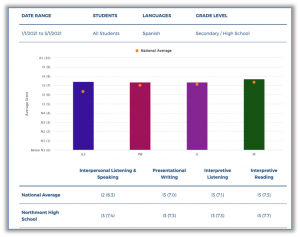
So is it working? What effect does sociocultural learning have on students as they work towards language proficiency? Our upper-level students all take the AAPPL test to identify Seal of Biliteracy recipients, and this year my CCP third-year students and our fourth-year students beat the national average scores on that test in all four categories, averaging above Intermediate Mid-3 (I-3) in each area and +1.2 over the national average for the Interpersonal Listening & Speaking.  Nine students earned the Seal with I-5 or higher in all four areas and eleven got I-5 or higher in three areas. Some are still waiting on results yet to come in, along with our German students who took the test for the first time this year.
Is it all sunshine and rainbows? Certainly not. We had a pen pal project set up with a school in Ecuador that totally flopped. There was a severe mismatch of ability levels in a couple of the video pen pal groups, and some of my students didn’t show up to their Meets. I didn’t give a few guests enough lead time to come in, and others were cancelled due to snow days. Many students who I began the year thinking were shoo-ins for the Seal of Biliteracy came frustratingly close or lost momentum this year.

As we head into the home stretch, savor those victories from the year and recognize those students who really grew. They might still sound rough around the edges but honor the work that they (and you) put in to get from where they started to where they are now. I’m looking forward to the next couple of weeks as my students will be presenting to each other about a variety of topics that they chose, from Machu Picchu to bee conservation to pets in Latin America.

Next year will be a whole new adventure, and I am proud to be an educator! ¡Feliz verano! Happy Summer!

The ACTFL Writing Proficiency Test Administered by LTI

As discussed in previous blogs, being able to speak English is not the only skill that employees who work in a global corporate environment need to have; being able to communicate by writing is also essential to remain competitive and gain success. A measure such as the ACTFL Writing Proficiency Test (WPT), administered exclusively through Language Testing International (LTI), is a valid and reliable assessment that measures how well a person spontaneously writes in a required language by comparing their performance in four to five specific writing prompts to the criteria stated in the ACTFL Proficiency Guidelines 2012—Writing. Topics included in the WPT range from practical to social and professional  that are usually encountered in both formal and informal contexts. The language proficiency level for this test is measured from Novice to Superior.

The ACTFL WPT is usually administered online. In cases where internet access might not be available, or for script/character based languages that present keyboarding challenges, a fixed form paper/pencil booklet is also available. In order to ensure an individualized assessment, candidates complete a Background Survey and a Self-Assessment. While the Background Survey provides information related to the candidates’ work, school, home, and personal activities to aid in identifying appropriate content areas, the Self-Assessment asks candidates to select one of six descriptions they feel most accurately describes their writing ability. Once these details are obtained, the computer then generates a WPT that is customized to each candidate’s experience, background, and self-assessed proficiency level. The computer can generate any of the three possible forms:

  • Form 1 targets Novice and Intermediate tasks and may be rated Novice Low to Intermediate Mid.
  • Form 2 targets Intermediate and Advanced tasks and may be rated Novice Low to Advanced Mid.
  • Form 3 targets Advanced and Superior tasks and may be rated Novice Low to Superior.

Even though the paper-pencil booklet does not include the Background Survey and  Self-Assessment, the tasks do increase in complexity throughout the test, just as they would in the fixed-form option, ranging from simple informative writing to descriptive, narrative, and persuasive writing.

Scoring

While the ACTFL Proficiency Guidelines are comprised of five major levels of proficiency – Novice, Intermediate, Advanced, Superior, and Distinguished, the WPT only tests proficiency through Superior. The major levels of Advanced, Intermediate, and Novice are divided into High, Mid, and Low sublevels. There are no sub-levels for Superior. The description of each major level is representative of a specific range of abilities. They also present the limitations that candidates encounter when attempting to write tasks at the next higher major level.

In assessing the writing ability of newly hired employees, or while making important hiring  decisions, having an assessment that is not only standardized but also provides individualized evaluations is highly valuable. The process of selection and hiring is one that usually requires a number of resources, not just in terms of time but also in terms of how the new hire will benefit the organization in the future. Upon hiring an employee, organizations are deciding to invest in that new incoming employee, therefore it is important that they have all the necessary information to make that decision. The ACTFL WPT, a standardized measure of an applicant’s writing ability in a given language, will enable organizations to make that decision. Prior to implementing a testing program, many clients undergo an LTI Task Analysis through which LTI works with a group of Subject Matter Experts (SMEs) nominated by the client to participate in a series of data collection activities to identify the communication tasks and functions; range of content/context areas; level of accuracy; and degree of elaboration needed to perform the bilingual position in question. This allows clients to set fair and appropriate, legally defensible minimum proficiency levels, as well as confirm/identify the necessary skills to be tested for the position. Given the increasingly globalized corporate environment that we live in today, employees that are proficient in multiple languages are more important than ever.

ACTFL’s Oral Proficiency Interview Delivered Exclusively by LTI

Given how important spoken English is in a corporate environment for employees to be successful, it is essential to talk about standardized measures that are currently being used to measure these skills. The ACTFL Oral Proficiency Interview, or just “ACTFL OPI®” is a holistic criterion-referenced assessment, because it measures a test candidate’s functional speaking proficiency in a given language on a range of tasks according to a specific set of criteria, and it does this within the context of a real-life exchange.  The criteria used during testing and rating of ACTFL OPIs® are the ACTFL Proficiency Guidelines, which identify five major levels of proficiency: Distinguished, Superior, Advanced, Intermediate, and Novice, the last three of which are divided into three further sublevels (High, Mid, and Low).

Since the focus of the ACTFL OPI® is on functional proficiency, and given its adaptive nature, the test does not focus on any set of content items that need to be covered, as with traditional testing formats. Instead, topics stem from the actual interaction between the candidate and the ACTFL-certified tester. ACTFL-certified testers are thoroughly prepared to ask questions purposefully to elicit the particular functions associated with each level of the ACTFL Proficiency Guidelines. This is done following a standardized structure consisting of four phases:

  1. Phase 1: The warmup — During the first four to five minutes, testers use conversation openers and open-ended questions that invite candidates to share general information about themselves.
  2. Phase 2: The level checks — These are questions targeting the functions and content areas that candidates can handle most comfortably, demonstrating the ability to sustain the assessment criteria while doing so.
  3. Phase 3: The probes — These are questions targeting the functions and content areas of the next higher major level that result in linguistic breakdown. They establish the ceiling or level where performance is no longer consistent and the assessment features associated with that level are no longer sustained.
  4. Phase 4: The wind down — This is the last phase of the ACTFL OPI®. It signals the end of the interview and allows candidates to regain a comfortable level to leave the interview on a positive note.

The scores reported to candidates follow the ACTFL Proficiency Guidelines 2012 – Speaking, which, as mentioned above, describe language proficiency along a continuum from the very top (Distinguished: highly articulate speakers of the language) to the very bottom of the scale (Novice: little or no functional proficiency)The current ACTFL OPI® only tests through Superior (general professional proficiency), and this is the highest rating candidates can receive, even if their performance surpasses the criteria for Superior. Therefore, the full range of possible scores reported to candidates includes: Superior, Advanced High, Advanced Mid, Advanced Low, Intermediate High, Intermediate Mid, Intermediate Low, Novice High, Novice Mid, and Novice Low. It is important to mention here that the ACTFL OPI® rating scale assumes that proficiency in the language increases substantially within the various global functions and throughout a hierarchy of those functions, rather than growing linearly in an additive fashion.

The ACTFL OPI® being a proficiency-oriented assessment with no recommended cut scores, means that it should result in a description of a candidate’s spontaneous, unrehearsed language abilities. This is important to underscore, because interactions in a corporate environment will not always be such where an employee gets time to think and then speak. Most of the interactions will be casual and in a collaborative setting. Thus, being able to measure spontaneity when it comes to language assessment is a significant positive.

The ACTFL OPI® is easy to use and convenient for candidates, who, while scheduling their test, can choose three possible time slots during which they are available to take the test. The ACTFL OPI® is delivered remotely and multiple proctoring options are available to meet any organization’s or individual candidate’s needs.

Why Language Training is Critical to a Business

The world is becoming more and more interconnected every day, and new technologies and digital platforms capable of bringing brands to any customer with access to the internet are the driving force behind this unstoppable phenomenon. Additionally, to help facilitate access to these new international markets, businesses are striving to increase cross-border trade, international investment, and labor integration.

The vision for most, if not all, business leaders is to turn their humble enterprises into international brands, and there are many reasons for this. For one, successful globalization not only helps companies access the latest industry-specific technologies and innovations, but also helps attract a wider customer base. Expanding internationally can also provide companies with plenty of chances to work with a highly diverse talent pool, enabling them to significantly lower production costs and increase global competition.

There are myriad ways companies can prepare for smooth globalization, one of which is by introducing language training. Below are some of the reasons why language training is critical to a business.

Language Training Upskills Employees

As highlighted in one of our previous posts, languages can be a gateway into another culture  and help companies nurture, foster, and maintain a truly diverse and inclusive workforce that can better communicate with a global customer base. This, in turn, can significantly improve customer retention and foster brand loyalty. Language training can also heighten employees’ cultural awareness and respect for others, thereby allowing them to connect effectively with customers and improve customer satisfaction. Companies that offer language training also demonstrate that they are willing to invest in their employees, thus making the company more attractive to prospective job applicants.

Language Training Improves Business Leaders

Mainstream employees aren’t the only ones who can greatly benefit from language training. In fact, business executives and administrators can also gain an array of competencies from learning a new language. Language training can make them better leaders who can empathize and build a stronger rapport with employees from all walks of life. In the long run, this can lower employee turnover, increase morale, and improve engagement. By working in a multinational company with employees from all over the world, business leaders will be better equipped to deal with conflict management because they are able to view situations from different perspectives. Proficiency in other languages has also been noted to help business leaders become highly perceptive and sound decision-makers who have a wide personal network.

Language Training Enhances the Hiring Process

One of the most desired skills for businesses, outside of regular training, is hiring employees who are multilingual. If you can train your HR department to have language skills, this will also widen your ability to hire globally. This is becoming more common within the business community because of the shift to remote working across the globe.

Language skills could also dictate which job seekers are worth hiring. With the business world now more interconnected globally than ever before, knowing a language gives any job applicant an advantage when seeking employment. For this reason, many choose to study languages while  at the college level as they prepare themselves to enter into the workforce. Studies show that completing at least a minor in a language while in college can boost academic achievement. The good news for students is that all top learning institutions offer foreign languages as a minor, and many students opt to combine them with business degrees to expand their career options. For anyone working toward a business administration degree, they will no doubt be looking to work for global companies, non-profit organizations, or in the government/public sector. All of these sectors often work or have offices abroad, giving those who have a business degree combined with language skills a wider scope for career advancement. A prospective employee who speaks a second language has in-demand skills that can set them apart from other applicants when applying for jobs.

Having people who can speak the languages of your diverse customer base will give your business an advantage over the competition. After all, this ensures that your company values and messages are accurately translated and delivered to foreign markets. In addition, a company capable of communicating in various languages will have a higher chance of working well with external branches, resulting in a locally driven international brand.

Once you’ve offered your employees language training, you will want to test their proficiency. Language Testing International (LTI) can help you with that task.

Since 1992, LTI has been a leader in language proficiency testing for more than 120 languages in over 60 countries. We are the exclusive licensee ACTFL, and to ensure the quality and validity of our tests are up to international standards, we use only certified ACTFL testers and raters.

Our accredited ACTFL language assessments are widely recognized and accepted by major corporations (from Fortune 500s to small businesses), academic institutions, and government agencies. Each test is designed to determine the specific proficiency level of an individual’s speaking, reading, writing, and/or listening abilities and ultimately to provide a valid and defensible rating language credential.