
Go Global, Grow Your Business, and Get Certified!

world globe puzzleGlobalization creates unlimited opportunities for industries worldwide. How can your organization go global and ensure that your efforts are successful? Your company’s potential customer base is virtually endless when barriers are broken down, including, but not limited to, language barriers.

Is your organization prepared to communicate, serve, and delight your customers?

Have you certified the language skills of your employees who are front and center?

An opinion article in the Training Journal indicated that “language learning will become an integral part of a company’s corporate strategy” as a means of improving international negotiations and relationships as well as internal business operations. This article is part of a growing body of evidence that suggests that corporations are in need of global language expansion in order to succeed. This goes hand in hand with recent reports that the demand for bilingual workers has doubled in the past five years (New American Economy, 2017, March).

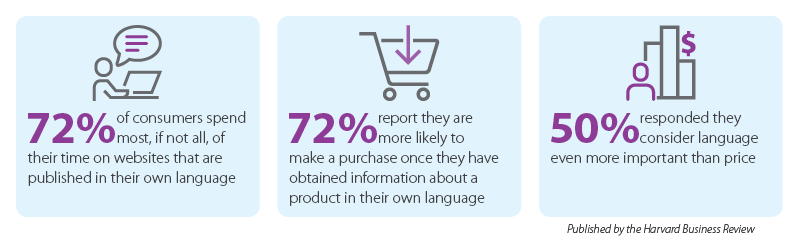
Successful global companies assess the language proficiency of their employees and unlock the potential of key global markets by using language assessments to certify the skills of their bilingual employees. Studies have shown that customers prefer to communicate in their native language, and “56.2% of consumers said that the ability to obtain information in their own language is more important than price.”
Language assessments allow you to better understand your employees’ actual language skills so that you can assign your team tasks that are the best fit for their level of language ability. Language testing is an essential part of any company’s global strategy.

Contact us and schedule a time with an assessment specialist to learn more about how Language Testing International (LTI) can assist you with your language testing needs.

Go Global, Grow Your Business, and Get Certified!

Why Language Proficiency Assessments Are Good for Employees and Employers


professional woman with headset in front of computerWhy Language Proficiency Assessments Are Good for Employees and Employers

Whether you have multilingual employees, plan to hire those who are, or want to encourage your staff to pursue a second or third language, it’s critical to consider certification of their language abilities. Certifying your employees’ language skills brings credibility to your company’s multilingual talent, and it has a positive effect on your employees’ morale and their ability to confidently do the job. You might be asking, do I also test current employees, or do I just test new candidates?

Here are some reasons why companies test every multilingual employee with a valid and reliable language proficiency assessment.

Employee Retention: Your employees are guaranteed to have the right level of language for the task at hand.

Language testing demonstrates the value you place on your employees’ talents and language ability. Certifying their skills ensures they have the appropriate level of language for the task at hand, giving them confidence and protecting you —the employer— should you ever need proof that skills are certified, qualified, and confirmed by a trusted and reliable source. Language certification is valid for two years.

Foreign Language Incentive Pay: Be fair to your employees and take the guesswork out of your assessment of language ability.

Many organizations offer foreign language incentive pay. How can you as the employer fairly determine who is eligible for additional compensation or a promotion? What happens when you have multiple candidates that self-select their eligibility? How do you make a fair assessment of an employee’s language proficiency and award incentive pay or even a promotion? Well-informed hiring managers and HR professionals use a third-party testing partner who specializes in language testing and rating.

Serve Your Multilingual Customers at Home and Abroad: Go global and grow!

Customers want to be understood, whether they are stateside or abroad. They are even willing to pay more if you can service them in a language they understand. Seventy-two percent of consumers spend time on websites in their own language. Sectors such as education, healthcare, and financial services actually require you to serve clients with limited English proficiency in their native language. Certifying your employees’ language skills will give you the peace of mind that they can indeed communicate in the required language, thus ensuring that your clients and partners are well-served.

Assess with Confidence, Fairness, and Equity, Language Testing International (LTI) administers language assessments to hundreds of thousands of candidates every year and is one of the largest and most respected foreign language proficiency test providers in the world. We offer the highest level of customer service as well as convenient online test scheduling, remote proctoring and secure reporting in customized client portals. Not sure what level of language is needed for the task at hand? LTI offers consultative services as well as validate and reliable research provided by subject matter experts to help you every step of the way!

Contact us today to learn more!

How will I share the AAPPL results with parents?

By Francesco L. Fratto, Director of World Languages, Language Immersion, & English as a New Language, LTI AAPPL Educator Panel

Francesco L Fratto

The Herricks Public Schools (NY) believes that monolingualism can be cured! Our small yet powerful district offers Chinese, French, Italian, and Spanish; in addition, we have a K-12 Spanish immersion program. The questions that parents often asked were how well can they speak Spanish and are they making progress? Academically our students do very well based on national, state, and local assessments; as educators we also knew that they were making progress with the Spanish language, but we needed more! AAPPL assisted us in answering the questions parents had! We tested all language immersion students grades three and above with the AAPPL Interpersonal Listening and Speaking. With very little to no preparation, our students responded appropriately to the online questions; the adults were more anxious than students! The friendly student format helped ease tensions. The results came in online and then I asked myself how will I share the results with parents?! Gregg Roberts, the architect of Utah’s Dual Language Immersion Model, shared what Kerrie Neu, Dual Language Specialist for the Granite School District (Utah), does in her district by offering parents a meeting to discuss proficiency and language acquisition. Out of her great idea, I scheduled our first Parent Proficiency Night; I too shared the process of learning a language, but I went above and beyond by including the data from the Interpersonal Listening and Speaking. We used Utah’s benchmarks to assist us in measuring our students’ growth. The AAPPL data was powerful! Parents were able to better understand the AAPPL measures of proficiency reports and left knowing what their children were able to do with the language. We can now speak with confidence about a student’s progress and the levels of proficiency we expect our students to reach at each grade level.

Overall the data has confirmed what we are doing right, but it has also challenged us to do things differently to strengthen the overall program. We are proud of our teachers, students, and parents who ask the right questions. We welcome the updated version of the AAPPL to help us dig deeper with respect to data.

What I Love about ACTFL

Iactft-2018-convention-logot’s always an exciting time right before Thanksgiving…not because of time off, yummy food, and time with family and friends (while those are exciting) but because it means that the Annual ACTFL Convention has arrived! As a district coordinator, my ACTFL week is a bit different from many; my learning starts on Tuesday afternoon. By the time ACTFL arrives, I’m ready to “relax” and take in sessions that I can immediately apply in trainings at home.

What I loved this year…

This year, learning more about the Intercultural Can-Do Statements was a huge theme. From listening to Frank Troyan lead us through how and why genre matters in lesson design to Ruta Couet and Jacque Van Houten sharing with us how the IC can-do’s should be the basis of curriculum. My biggest takeaways from these sessions were questions I could ask when I visit classrooms: what is the can-do? What is the evidence that students mastered the can-do?  How can students use the can-do tomorrow? Very powerful questions when working with teachers.

I am so very excited about the new Language Resource Center at the University of Maryland: Professionals in Education Advancing Research and Language Learning (PEARLL) led by Thomas Sauer. Being a one-person show in my district (i.e. no specialists), I have many ideas but not enough hours. PEARLL is going to be a huge asset to my work in helping teachers to be the best they can possibly be.

I always enjoy hearing Greta Lundgaard. Her session on tips for surviving curriculum revision was just what I needed to get me through the remainder of the school year. Being in the midst of keeping a team motivated while rewriting a framework to be proficiency-based is my daily reality. However, I am challenged by keeping the motivation going long-term and garnering the strength and energy to tackle the revision process once the rewrite is completed. Greta is always inspirational and spot-on with her observations and takeaways.

What I love year after year…

What I love about ACTFL is the generous, sharing spirit that most presenters have. It is such an opportune occasion to attend the sessions from the leaders in the profession. And, if you haven’t had a chance to meet them, it’s easy to go up and introduce yourself or ask a follow-up question. Almost without fail, every presenter is willing to engage in conversation either right then or a bit later. ACTFL is the place to make connections and build your professional learning network. Our work is hard enough; we don’t need to isolate ourselves from others but we need to build bridges so we can work together towards our common goal.

The other marvelous aspect of the ACTFL Convention is the variety of sessions offered. When I have the opportunity to bring teachers from my district, I always advise them to figure out ahead of time what sessions they wish to attend; to choose the sessions that have meaning to them; and, then if they are in a session that doesn’t “speak” to them, move somewhere else. If they leave ACTFL without gaining a lot, it is really their own fault. The sessions are there:  formal sessions, panels, papers, and unconference-type discussions. A variety of input to meet the needs of thousands of educators.

While I am always ready to come home at the end of ACTFL, it’s bittersweet. I have a convention family that I am able to spend time with and learn from for a week out of the year.  That is what I look forward to the most every year.