 There’s so much to consider when hiring a potential candidate at any company. Reviewing resumes and checking references have always been the norm but when and where does social media come into play?
There are some fine lines that both HR professionals and candidates alike need to be mindful of when it comes to social media posts and the conclusions that can be drawn from them. An example would be making a hiring decision upon discovering personal information such as a pregnancy or if the candidate is getting married and likely requiring time off in the not-too-distant future. Making hiring decisions based on this information would be legally problematic under these circumstances and others similar.
Continue reading
 Job seekers place too much focus on answering the hard
  The American Council on the Teaching of Foreign Languages (ACTFL) developed a scale to demonstrate the main language functions that a learner can perform with full control at each of the major levels. The
 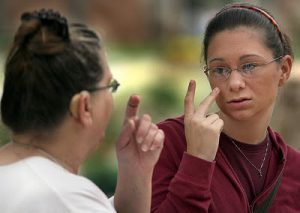 American Sign Language, or even simple gestures are processed by deaf people in the part of the brain that is used for spoken language, according to a recent international research study headed up by a neuroscientist from Dalhousie University in Halifax, Nova Scotia, Canada. Using functional magnetic resonance imaging (fMRI), Aaron Newman, Associate Professor with the university’s Department of Psychology and Neuroscience, and collaborators Ted Supalla and Elissa Newport from Georgetown University, student Nina Fernandez, and Daphne Bavelier from the Universities of Geneva and Rochester, were able to show those who are congenitally deaf process signs and gestures in the left hemisphere of the brain. Those test subjects who were not deaf and not users of sign language processed the information in the portion of the brain used to process human movement. “It is a basic science study, with no immediate implications for people in the area of health,” Newman said in an interview.