Three Ways to Upskill Your Multilingual Capabilities

Three professionals, closeup

Is it really as easy as 1, 2, 3? Ok, it may not be “easy,” but it is doable!

To upskill your multilingual capabilities, you need a superpower mindset. According to Marvel Comics writer and artist Jonathan Hickman, “Newfound power leads to new perspective.” So, whether you are looking to advance in your career, enhance your travel experiences abroad, support a family member in their healthcare journey, or any other life experience you can think of, if you can communicate in more than one language, you understand that you need to continuously learn, grow, and take your skills to new heights. Here are three power-packed tips to help you upskill your multilingual capabilities:

Step 1. Assess and elevate your proficiency level

The best way to determine your language competency level now is to complete an assessment. You want to be able to measure how well you are mastering one or more languages, as well as your level of proficiency. According to the ACTFL Proficiency Scale, your level of language ability corresponds to various language functions and tasks.
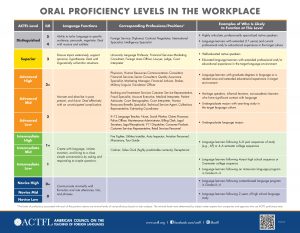
Oral proficiency levels in the workplace

(Click on the image to view it in a larger format)

Once you determine your current level of language proficiency, you can strengthen your linguistic skills through formal and informal learning opportunities to elevate your communication skills in another language to a higher proficiency level.

Step 2. Determine the right level of language needed for the task at hand

When you are navigating between multiple languages, in addition to your linguistic skills, you need to consider your cultural awareness of the situation. Consider character, context, culture, and competency as you determine the right level of language skills you will need to use depending on who you are communicating with, the situation you are involved in, the appropriate cultural norms for the circumstances, and how prepared you are to address them effectively.

When leveraging language skills for career advancement within a specific industry, Celia Patitucci, a bilingual HIV tester and educator based in Orlando, Florida, affirms that, “You need to be proficient in a professional setting. For example, for someone that speaks Spanish, when it comes to a professional level it does not always translate as there are terms and terminology [specific to the industry] that you need to learn.” For example, while a native Spanish speaker may be proficient in conversational and social settings, if he or she wants to advance career-wise in healthcare, it becomes necessary to learn medical terminology, the appropriate use of that vocabulary, and its application within the medical field.

Step 3. Certification is validation

As the saying goes, “The proof is in the pudding.” While we are not serving up pudding, there is a sweet sense of accomplishment when you obtain an official ACTFL language proficiency certification through LTI. Verification of your language proficiency level, not only in your heritage language but also languages you learned at school, affords you the authority to claim that superpower that makes you stand out and elevates you to new heights in all aspects of life.

To learn more about upskilling your multilingual capabilities and showcasing that language is indeed your superpower, visit Language Testing International (LTI) today!

And if you want to listen to Celia Patitucci’s story, listen to our most recent podcast.

Commit to Providing Linguistically and Culturally Competent Offerings to Diverse Market Segments

collage of people on a video conference

Through the many sectors, industries, and communities that Language Testing International (LTI) supports across the world, we have been able to observe, experience, and be a part of many business and societal trends. One of these trends, especially within the U.S. market, has been the shift in the American business mindset into attempting to become more culturally competent, albeit with varying success. So, how do organizations navigate this journey, and what are the best practices to shift your organization to a better position to succeed?

Overwhelmingly, the workforce and the consumer market of goods and services in the U.S. has called for Corporate America to not only deliver a great product and/or service, but also to be culturally competent and fully committed to social responsibility, diversity, equity, and inclusion. There is no denying that businesses, service providers, and even government agencies have felt the societal and financial pressures to shift internally and prioritize ethical/equitable hiring processes and an inclusive work culture, as well as externally in the ways they market to their customers.

Whether in a dynamic business marketplace, where prospective employees and customers have many options, or a nonprofit service or healthcare clinic, where vulnerable members of the community may be hesitant to seek help for fear of not being heard or understood, the keyword you must remember, and which you will be evaluated on, is “authenticity.”

While taking yourself and your organization through this shift is necessary to stay relevant and competitive, there are a lot of risks involved for your reputation and your bottom line if you have a misstep or do it incorrectly. What many have found out the hard way is that making your organization linguistically and culturally competent is not a strategy that can be drawn up in a boardroom by a group of individuals who do not represent the communities or cultures they are trying to reach, nor is it a line item that can simply be added to a list of offerings.

Becoming linguistically and culturally competent with authenticity requires a wholehearted commitment to systemically overhaul every aspect of your business; from company values and ethics, and how and who you hire, to how you train and treat your employees; from what services or products you provide and how you communicate those to your audiences, to how you treat prospective and current customers.

Celia Patitucci’s work is a great example of successful and effective cultural competency practices. Celia is an HIV tester and educator who has worked since 2016 in programs focused on the prevention of HIV and other sexually transmitted diseases. In a recent episode of LTI’s podcast LANGUAGE IS YOUR SUPERPOWER, Celia shared key insights with us from her experience, and what steps the organizations she has worked with have taken to successfully navigate this terrain.

Approximately half of the LGBTQ+ community members Celia serves are Spanish-speaking Latinos. Celia helped her former employer grow its staff to include more than 50% Spanish speakers. Celia stresses, however, that you need to have “not only Spanish-speaking employees, but also, culturally competent” employees, because “it’s not just knowing the language, it’s knowing the culture” as well.

Celia explains that this organizational shift must be implemented “in every capacity, from medical to receptionists … having a website, bilingual and in dual language,” and “whatever marketing material is specifically for whatever community we’re targeting. [We’re] not just having blanket marketing or … just translating it to Spanish. That is not what we want to do any more.”

In her field of providing medical services to Hispanic members of the LGBTQ+ community, Celia explains that “we want people to come over, and we want people to get tested, and we want people to keep within their medications. You have to target it in a cultural way. You have to provide content not just by translating it from English but in a culturally sensitive way.” She added, “when we do events … [we’re] making sure that [whoever] we’re targeting that we’re doing it appropriately for that community.”

Celia’s work goes to show how valuable hiring multilingual employees can be for organizations and communities in making this systemic shift, but also, how language is not going to carry you through this shift alone. Hiring and/or training individuals who are linguistically and culturally competent in understanding the audiences you are trying to reach, and who are also a reflection of your audiences, is invaluable. And to ensure it’s done authentically; these individuals should be included in every step of your strategic planning and in the implementation of this shift. Pair their cultural competency with language proficiency certification, and you will be well on your way to navigating this journey successfully.

Get started today. Visit www.languagetesting.com for more information.

Listen to Celia’s story in her own words in the second installment of our LANGUAGE IS YOUR SUPERPOWER podcast series here.

Leverage Your Linguistic and Cultural Competencies

If you can communicate in more than one language and navigate more than one culture, your multilingual skills can be leveraged to serve our increasingly diverse society. When you think of all the various aspects of life—work, school, home, socializing, volunteering—there are many contextual opportunities to leverage your language abilities and your cross-cultural competencies to make an impact. This becomes even more meaningful when you work in an industry like healthcare, where the language you speak, the culturally diverse individuals you interact with, and cultural nuances may challenge access to services or the ability to receive quality care. Having the language and cultural proficiency to effectively manage health-specific situations can be instrumental in ensuring long term positive outcomes.

A 2019 study by BMC Health Services explored the views of healthcare providers regarding cross-cultural competence in the workplace. It was found that “language barriers, low client health literacy and bureaucratic constraints are regularly offered as barriers to effective cross-cultural service delivery.” A good example of that was during the aftermath of the 2016 Pulse massacre in Orlando, Florida, which left 49 people dead and more than 50 people wounded—most of whom were primarily Hispanics from the LGBTQ+ community. How well emergency services, the police, news outlets, and other first responders were able to address and effectively communicate the circumstances was critical. In responding and during the aftermath, the importance of being able to speak in the language of preference of the victim’s families, and with the cultural understanding of the population under stress became blatantly evident. From informing families about their loved ones in a language and cultural context that they could understand to delivering devastating details about the tragedy, linguistic proficiency and cultural competency were evidently needed. Therefore, public, private, and nonprofit organizations increased their focus on identifying the right individuals with the skillsets to provide primary, acute, and other healthcare services that were culturally competent, linguistically appropriate, and with an understanding of the unique needs of the Hispanic LGBTQ+ population.

In a recent LANGUAGE IS YOUR SUPERPOWER podcast episode about the impact of language proficiency in healthcare, the conversation highlighted the importance of leveraging one’s linguistic and cultural competency to best serve the community. “Most of our demographic—approximately 50% of our clients—are Spanish speaking, and that part of the community, for many years, were [sic] not targeted,” stated Celia Patitucci, a bilingual HIV educator and tester. “Now that a lot of agencies are being more conscientious about having not only Spanish speaking employees, but also cultural [sic] competent [employees]…it’s not just knowing the language, but knowing the culture is important.”

As a person that commands more than one language, you can leverage this as your superpower. Whether you are in the healthcare field or not, the ability to speak, write, read, and effectively communicate in more than one language increases your access to cross-cultural job opportunities and gives you the chance to be a champion for diverse communities. With an ACTFL language proficiency certification through Language Testing International (LTI), you will gain an official badge to demonstrate your ability to use your superpowers to make a meaningful difference—at work, school, home, socially, or when you are out in the community.

Learn more about how to get certified at www.languagetesting.com.

Sources:

https://bmchealthservres.biomedcentral.com/articles/10.1186/s12913-019-3959-7

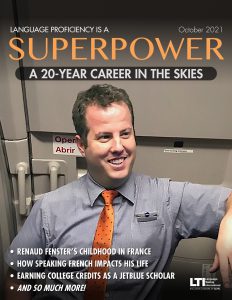
Meet a Language Superhero: Renaud Fenster

At LTI, we often talk about the benefits of being multilingual, and we truly believe that multilingualism gives you a special power: a power to communicate in another language, a power to better understand other cultures, a power to give yourself a competitive advantage, and even a power to save lives.

Every year, thousands of professionals take the ACTFL language assessments with LTI to certify their language skills and use the official credentials to showcase their multilingualism. One of these professionals is Renaud Fenster, a flight attendant at JetBlue. Renaud’s story is interesting and inspiring, and we are proud to feature it in our very first Language Proficiency Is a Superpower Magazine.

We hope you take the time to read Renaud’s story and get inspired to get your language skills certified.

Click to read and/or download Renaud’s story: Renaud-Fenster-Story